Garrett County Dog Registration Information
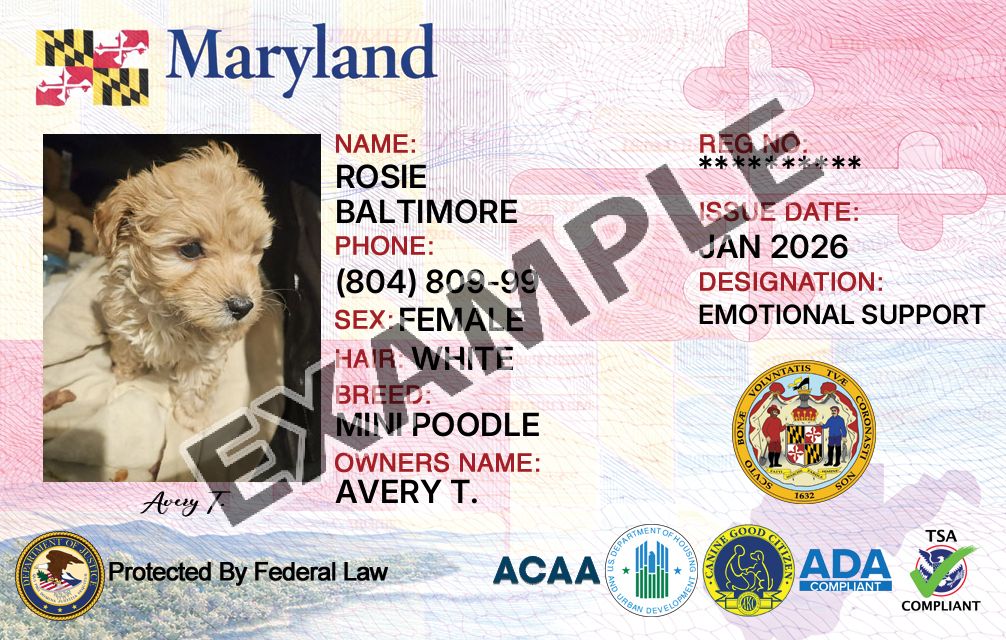
Service Dogs and Emotional Support Animals in Garrett, Maryland
If you’re searching where do I register my dog in Garrett County, Maryland for my service dog or emotional support dog, the key point is this: the “registration” most residents need is a dog license in Garrett County, Maryland, which is handled locally, and it is separate from any disability-related status under service dog laws or emotional support animal (ESA) rules.
This page explains how local dog licensing works, what rabies documentation is typically required, and how to avoid confusion between an animal control dog license Garrett County, Maryland residents need for compliance and the rules that govern service animals or emotional support animals.
Where to Register or License Your Dog in Garrett County, Maryland
Because licensing is typically handled at the local level, the following are example official offices in Garrett County, Maryland that are commonly involved with animal control, shelter services, and rabies-related public health information. Contact the office that best matches your need (licensing questions, animal control enforcement, or rabies vaccination/rabies exposure guidance).
Garrett County Animal Control & Shelter (Sheriff’s Office)
Garrett County Sheriff’s Office (Main Office)
Garrett County Health Department (Oakland Main Office)
Garrett County Government (Main Contact Listing)
Overview of Dog Licensing in Garrett County, Maryland
What a county dog license is (and what it isn’t)
A county dog license is a local license tied to your dog and your residency. In Garrett County, Maryland, local law provides for annual licensing and the issuance of a license tag that should be attached to your dog’s collar. A dog license helps local officials identify owned dogs, supports animal control operations, and reinforces public health requirements such as rabies vaccination.
A dog license is not any of the following:
- Not a “service dog certification” or a federal service animal ID
- Not proof that your dog is a legally protected service animal under the ADA
- Not an emotional support animal (ESA) letter or housing accommodation approval
Who is responsible for licensing in Garrett County
Licensing is handled locally in Garrett County. County rules and enforcement commonly involve local government functions such as animal control and county administrative offices. State law also includes dog licensing provisions specific to Garrett County, including that dog owners must apply to the county tax collector for a license and that licenses are renewed annually around a July-to-July cycle.
Rabies vaccination requirements (Maryland)
Maryland law requires dogs (and also cats and ferrets) over a certain age to be vaccinated against rabies. The Garrett County Health Department publishes local rabies clinic information and reminders, including that rabies vaccination is required by state law and that vaccination schedules vary based on age and species (for example, puppies and kittens typically receive an initial dose and then a booster one year later, while adult dogs and cats may be vaccinated on a multi-year schedule as directed by a veterinarian and consistent with public health guidance).
How Dog Licensing Works Locally in Garrett County, Maryland
Step-by-step: how to get a dog license in Garrett County, Maryland
- Confirm where to apply. Garrett County licensing is handled locally (and state law refers to applying to the county tax collector). If you are unsure which office processes applications day-to-day, call Garrett County Animal Control & Shelter or the main county government line and ask where to submit a dog license application.
- Gather your documents. Most counties require proof of rabies vaccination, plus basic owner identification and residency details. (See the “What You May Need” sidebar.)
- Apply and pay the fee. Local licensing typically requires a fee set by the county. Ask the office what payment methods are accepted and whether discounts apply (for example, for spayed/neutered pets, seniors, etc., if applicable).
- Receive and attach the tag. A county dog license commonly includes a numbered metal tag. Attach it to a sturdy collar and keep it on your dog except in the limited situations allowed by local rules (for example, when confined).
- Renew on time. Garrett County dog licenses are annual (license expiration is tied to a July-to-July cycle). Put a reminder on your calendar and renew before the expiration date to avoid penalties or complications if your dog is picked up or needs to be reclaimed.
Why the “animal control dog license Garrett County, Maryland” search term matters
Many people find licensing help through animal control because animal control is a primary enforcement and community-facing agency for pet-related rules. Even if another county office processes the actual license paperwork, animal control can typically point you to the correct licensing process, explain what to do if your dog is found without a tag, and help clarify local ordinance requirements.
Common misunderstandings (service dog / ESA vs. dog license)
A frequent mistake is assuming that a “service dog registry” or an online ID card replaces county licensing. It usually does not. Even if your dog is a trained service dog or an emotional support animal, local licensing and rabies requirements generally still apply. The rest of this page breaks down the practical differences so you can register (license) your dog correctly and understand your rights.
Service Dog Laws in Garrett County, Maryland
What makes a dog a service dog (legal meaning)
A service dog is generally a dog that is individually trained to do work or perform tasks for a person with a disability. The legal protections most people think of (such as access to public places) come from disability law—not from a county dog license, a vest, a tag, or an online “registration.”
Do you need to “register” a service dog in Garrett County?
For most residents, the practical answer is: you need to license your dog locally (a standard dog license in Garrett County, Maryland) and comply with rabies vaccination rules, but you do not typically need a special county “service dog registration” to have a service dog protected by disability law.
How dog licensing relates to service dogs
A service dog can still be subject to neutral, generally applicable public health and safety rules—like rabies vaccination and local licensing—so long as those rules are applied consistently. If you’re asking “where do I register my dog in Garrett County, Maryland for my service dog,” start with the same local offices listed above for the county dog license, then separately maintain any documentation you use to support disability accommodations (as needed for specific situations).
Emotional Support Animal Rules in Garrett County, Maryland
What an emotional support animal is (and isn’t)
An emotional support animal (ESA) is typically an animal that provides comfort or support that helps with a person’s mental or emotional disability, and it is most commonly relevant in housing contexts. ESAs are not the same as service animals trained to perform tasks, and ESAs do not automatically have the same public access rights as service dogs.
Do you need to “register” an emotional support dog in Garrett County?
If you mean “register” as in a county license: yes, you generally still need the standard dog license in Garrett County, Maryland and to meet rabies vaccination requirements. If you mean “register” as in legal ESA status: that is usually handled through a housing accommodation process supported by documentation from a qualified healthcare provider (not through county licensing).
How dog licensing relates to ESAs
A local dog license is about county compliance and identification (tag, renewal cycle, and rabies documentation). ESA documentation is about requesting reasonable accommodations in housing. If you’re trying to do both, handle them as two separate checklists: (1) local licensing and rabies compliance through county offices, and (2) ESA housing accommodation documentation through your healthcare provider and your housing provider’s accommodation process.
Frequently Asked Questions
Register A Dog In Other Maryland Counties
Select your county below to get started with your dog’s ID card. Requirements and license designs may vary by county, so choose your location to see the correct options and complete your pup’s registration.
- Allegany County Dog Registration
- Anne Arundel County Dog Registration
- Calvert County Dog Registration
- Caroline County Dog Registration
- Carroll County Dog Registration
- Cecil County Dog Registration
- Charles County Dog Registration
- Dorchester County Dog Registration
- Frederick County Dog Registration
- Harford County Dog Registration
- Howard County Dog Registration
- Kent County Dog Registration
- Montgomery County Dog Registration
- Prince George’s County Dog Registration
- Queen Anne’s County Dog Registration
- Somerset County Dog Registration
- St. Mary’s County Dog Registration
- Talbot County Dog Registration
- Washington County Dog Registration
- Wicomico County Dog Registration
- Worcester County Dog Registration